Veterans Research Study
HBOT for TBI, PTSD, and Cognitive Recovery
Traumatic experiences faced by veterans often lead to a range of mental health challenges, including PTSD, depression, and anxiety. Many veterans also experience Traumatic Brain Injury (TBI) and Post-Concussion Syndrome (PCS), which can contribute to cognitive impairments and reduce overall quality of life.
Hyperbaric Oxygen Therapy (HBOT) is a promising intervention that delivers pure oxygen under increased pressure to improve tissue oxygenation and promote healing. This FDA-authorized, IRB-approved IND study (IND #177976) aims to investigate the effects of HBOT on cognitive function and on symptoms of TBI, PCS, PTSD, depression, and anxiety in veterans.
Study Objectives
What We Aim to Discover
Primary Objective
To evaluate the effects of HBOT on cognitive function and symptoms of PTSD, depression, and anxiety in veterans. Outcomes will be assessed using validated instruments measuring attention, memory, processing speed, and symptom severity.
Secondary Objective
To examine the effects of HBOT on quality of life in veterans, using a standardized instrument that evaluates physical health, mental health, social relationships, and overall well-being.
FDA-Authorized, IRB-Approved IND Study
What Does This Mean?
This research study is conducted under an Investigational New Drug (IND) application (IND #177976) that has been authorized by the U.S. FDA. An IND allows for the clinical investigation of a drug or therapy for uses not yet approved by the FDA.
What is an IND?
An IND application is a request for FDA authorization to administer an investigational drug or therapy to humans. The FDA reviews the IND to ensure that the proposed study does not place human subjects at unreasonable risk.
Why is This Important?
FDA authorization of our IND means that the agency has reviewed our study design, safety protocols, and qualifications, and has determined that it is reasonably safe to proceed with our clinical investigation.
Regulatory Oversight
This study is conducted in compliance with FDA regulations and Good Clinical Practice (GCP) standards. All adverse events are promptly reported, and participant safety is continuously monitored.
What is an IRB?
An Institutional Review Board (IRB) is an independent ethics committee that reviews and approves research involving human participants. The IRB ensures that participant rights, safety, and welfare are protected throughout the study.
Important Note: While HBOT is FDA-approved for specific conditions such as decompression sickness and carbon monoxide poisoning, it is not currently approved for the treatment of TBI, PCS, or PTSD. This study investigates HBOT for these indications under FDA oversight. Participation in this study does not imply FDA approval of HBOT for these conditions.
Why Participate?
Help Advance Treatment Options
HBOT is an investigational treatment that has shown promise in improving cognitive and psychological conditions, including TBI, PTSD, depression, and anxiety. HBOT may be used as an adjunctive therapy to conventional treatments or as a primary intervention when other therapies have not provided benefit.
Participation in this research may help develop more effective treatment options for veterans, first responders, and other charitable populations experiencing cognitive and psychiatric conditions, potentially improving quality of life for individuals beyond the study population.
Who is Eligible?
Participant Criteria
Participants must be veterans aged 18–75 and meet one or more of the following criteria:
- History of TBI
- History of PCS
- Experiencing ongoing symptoms related to TBI or PCS
- Diagnosis of PTSD or experiencing symptoms of PTSD
Study Procedure
What to Expect
After providing informed consent, participants will undergo a comprehensive baseline evaluation, which includes:
- Review of medical history and physical examination
- Assessment of oxygen levels, ear and sinus health, cardiovascular and neurological function
- Laboratory tests
- Comprehensive behavioral health assessment
Once approved to participate, participants will complete a battery of cognitive and psychometrically validated measures at baseline (pre-treatment) and after completing the HBOT sessions (post-treatment).
HBOT Protocol
Treatment Session Details
Each HBOT session lasts approximately 95 minutes:
Descent
Gradual pressurization to 2.0 ATA (longer if needed for comfort/safety)
Oxygen Breathing
Breathe 100% pure oxygen
Air Break
Brief period breathing normal air (may be extended for participant comfort)
Oxygen Breathing
Another session of 100% pure oxygen
Ascent
Gradual depressurization back to 1.0 ATA (may be extended for participant comfort)
Participants will receive 2 HBOT sessions per day, Monday through Friday (excluding holidays), completing a total of 40 sessions within approximately 4–5 weeks. A recovery interval of at least 4 hours will occur between sessions.
Safety
Your Well-Being is Our Priority
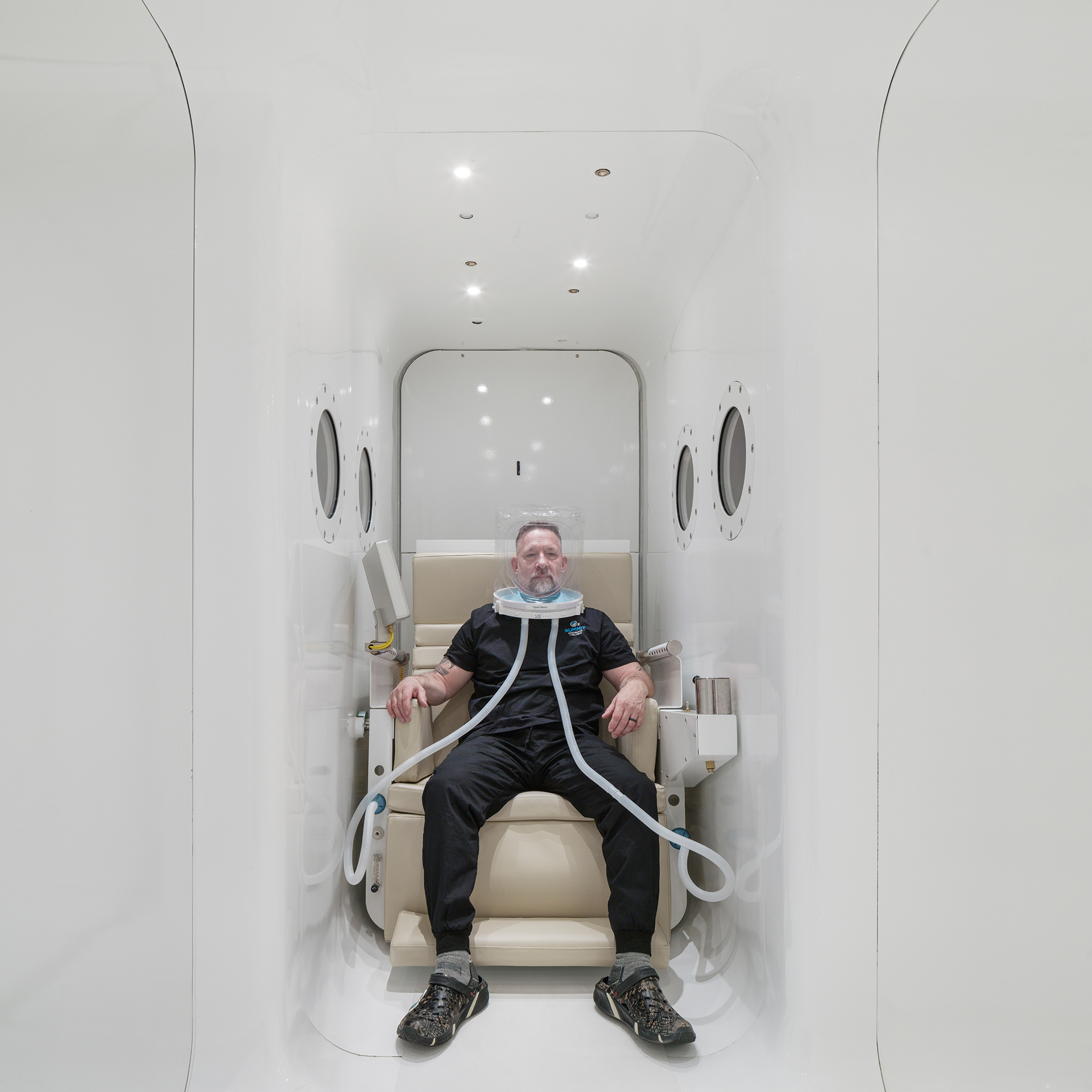
HBOT is conducted under strict medical supervision to ensure participant safety. All sessions are monitored by trained healthcare professionals, with a licensed physician on site—a level of oversight that many other clinics providing HBOT lack. Participants undergo comprehensive medical and behavioral health screening before enrollment.
During each session, vital signs, oxygen levels, and overall health are continuously observed. Special attention is given to ear, sinus, cardiovascular, and neurological health to prevent complications. Any adverse events or side effects are addressed promptly according to established safety protocols.
Our conservative treatment protocol (2.0 ATA for 60 minutes with a 5-minute air break) is designed to maximize therapeutic benefit while minimizing risk. This regimen is consistent with previous clinical trials demonstrating significant cognitive and psychological benefits in veterans.
Clinical Monitoring
Comprehensive Health Assessments Throughout the Study
Participant safety and progress are closely monitored throughout the study. Our clinical monitoring program ensures that we track your health and response to treatment at every stage.
Weekly Assessments
- Otoscopy (eardrum examination)
- Barotrauma screening
- Vision checks
- Vital signs monitoring
- Physical exams
- Medication reviews
Lab & Heart Tests
At baseline, mid-treatment, and end of study
- Complete Blood Count (CBC)
- Comprehensive Metabolic Panel (CMP)
- Electrocardiogram (ECG)
Outcome Assessments
Pre- and post-treatment
- Cognitive testing (NeuroTrax)
- PTSD symptoms (PCL-5)
- Anxiety symptoms (GAD-7)
- Depression symptoms (PHQ-9)
- Quality of life (WHOQOL-BREF)
Ready to Participate?
Join Our Research Initiative
Your participation in this research study can make a real difference—not only for yourself but for veterans across the country who may benefit from HBOT in the future.
Contact us today to learn more about eligibility requirements and how to enroll in the study.